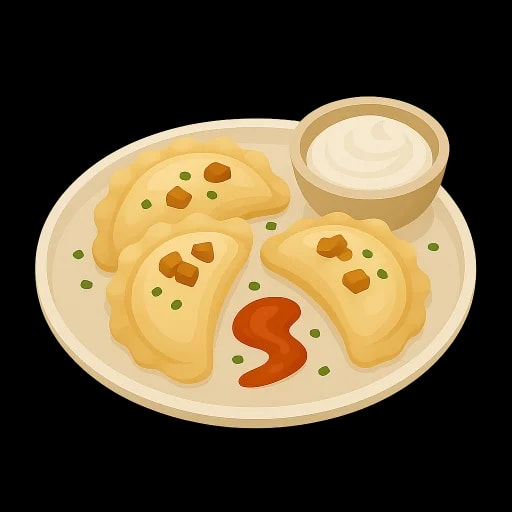
Pierogies and cabbage rolls are the backbone of Unique Food Attitudes. The kitchen builds most of a lunch around them: a Polish plate pairs a krokiet or a cabbage roll with four or five pierogies, a daily soup goes on the side, and a paczek comes from the case to finish. The menu is meant to be assembled — a working Polish repertoire rather than a single novelty plate ordered on its own. The storefront sits on Dundas Street in London's Old East Village, keeps daytime hours geared to the weekday lunch and the takeout bag, and has cooked to that rhythm since 2012.
The pierogies come in the standard fillings — meat, potato and cheese, sauerkraut and mushroom — plus a strawberry version that slides them toward dessert. Cabbage rolls arrive in a tomato braise, with a vegetarian one under wild mushroom sauce for tables that need it. From there the Polish range deepens: bigos, the long-simmered stew of sauerkraut, meat and mushroom; goulash spooned over potato pancakes; krokiety, crepe rolls stuffed with sauerkraut and mushroom and set beside a bowl of red borsch. Heavier plates round it out — a breaded pork cutlet, a cutlet sandwich, sausage on a bun. The clearest modern turn is the Polish poutine — six cheddar pierogies buried under goulash sauce — which takes the dish this country is known for and rebuilds it out of the kitchen's own staples.
The Polish core anchors a menu that keeps a full daytime counter going around it. Gluten-free and dairy-free versions sit beside the cabbage rolls, the daily soup and the goulash, and the vegetarian cabbage rolls come under their own wild mushroom sauce rather than as a substitution. The breakfast and lunch board fills in the rest of the day — deli sandwiches on rye or ciabatta, omelettes, crepes folded around ham and swiss or mushroom and cheese, French toast in the morning. It is the range of a kitchen that expects regulars, not just the diner who drove across town once for pierogies.
The sweets get the same attention. The case turns out paczki — the filled Polish doughnuts dusted with sugar — alongside a Polish cheesecake set with gingerbread cookies, apple cake, and a triple chocolate brownie for the diners who didn't come for the heritage plates. Much of it can be ordered ahead: paczki by the dozen, frozen soups by the tub, breads to take home — the kind of pre-order list that turns a lunch stop into the supply run for a weekend gathering.
The restaurant grew out of a kitchen that was already working. Barbara Czyz ran catering before she opened the storefront, and the menu still reads like the work of someone used to cooking in volume for other people's occasions — generous plates, food that holds up in a box, nothing fussy enough to fall apart on the drive home. Local reporting credits her family recipes as the heart of the cooking, and the Old East Village's Dumpling Trail has folded the pierogies into the neighbourhood's self-guided eating circuit. The setting leans modern — bright and contemporary against food that is anything but — which keeps a heritage kitchen from tipping into nostalgia.
Thursdays bring zurek — the sour rye soup with sausage and egg that rarely turns up on a London menu — and the daily soup changes with the day, so the week here is marked in its pots more than on any specials board. It is a heritage kitchen keeping lunch-counter hours, as ready to send a tray of dinner home as to plate one for a midday table. In a city where most Polish cooking happens in someone's kitchen, a storefront that does it at noon and lets you carry it out is its own quiet argument.