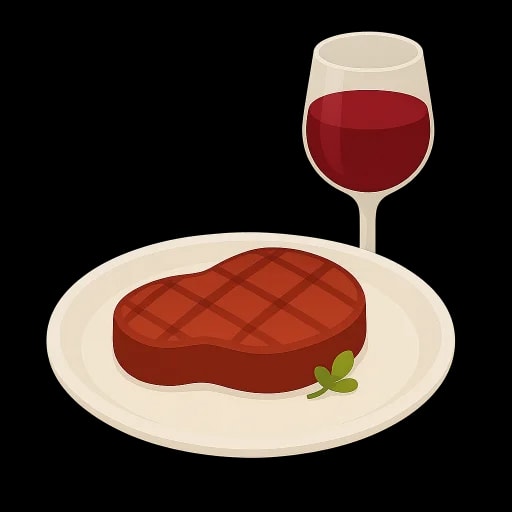
The beef is cooked over charcoal. That was the founding premise on Elm Street, and it still governs the kitchen: dry-aged cuts seared over live coals, sent out plainly and trusted to speak for themselves. The steaks lead — a sixteen-ounce bone-in rib, a twenty-four-ounce cut for a larger appetite, a thirty-two-ounce porterhouse built to be shared across the table. The dry-aging concentrates the beef before it ever reaches the grill, and the rest of the menu arranges itself around what comes off it.
Before the grill takes over, the meal opens cold and precise. Hand-cut steak tartare is the sharper way to start than another hot plate, and it is one of the dishes singled out by a national restaurant ranking. The appetizers run classic and unhurried — escargots in garlic butter, oysters Rockefeller, smoked Atlantic salmon, French onion au gratin, a brandied lobster bisque, a wedge salad named for the founder. The entrées hold the centre: a bacon-wrapped filet mignon, a centre-cut top sirloin, a New York strip, Chateaubriand carved for two, a surf and turf of petite filet and half a lobster. Even dessert keeps the house name, in Harry's classic sundae.
The setting is not a backdrop. Barberian's occupies an 1860s building, and the dining room is hung with Canadiana — historic artifacts, sculptures, Group of Seven canvases — so the walls carry as much Toronto as the plates do. This is white-tablecloth dining of an older Toronto, run on charcoal rather than convenience. The operating model matches the surroundings: regular tables are booked by telephone only, groups and private dining by email. The front dining room was added in 1961 and the back extended in 1969 — the building grew the way the business did, one dining room at a time.
The deepest part of the story sits literally below the floor. In 2006 the restaurant dug a two-storey subterranean wine cellar with a thirty-foot ceiling, putting the family's wine legacy directly beneath the dining tables — a cellar deep enough to support a rotating guest-sommelier program. Harry Barberian opened the steakhouse in 1959 as a tribute to charcoal grilling, and by the family's account he became a Toronto restaurant pioneer — an entrepreneur and host to prime ministers and movie stars. His son Arron took over operations in 1994, after the family bought back a controlling share, and has run it as owner and steward since. Local reporting describes Arron's civic work around Yonge-Dundas Square and the annual Harry Barberian Memorial Dinner, which the family launched in 2013 to fund hospital research.
The breadth is what makes it workable for more than a date night. Regular tables seat parties of seven or fewer; anything larger moves to private dining, where a mezzanine off the cellar holds fifteen, a lower cellar level seats thirty, and the two can combine for forty-five. An upstairs library room with its own washroom and audiovisual setup takes sixteen, and a round-table room seats eight. The kitchen flexes the same way: there is usually a halal-slaughtered steak on hand, children get highchairs and half orders of prime rib or baby back ribs, and the midweek lunch service brings a daytime trade the evenings never see.
What all of it serves is the occasion. Barberian's is where a table goes when the night itself is the point — a deal closed, an anniversary, a visitor who wants the old Toronto rather than the new one. The order ends the same way whether the table is booked on the main floor or two storeys down in the cellar: charcoal-grilled beef, and a bottle to match it. That was Harry's premise in 1959, and it is still the one Arron runs.