Oroshi Fish Co. treats the fish before it treats the customer. The College Street shop dry-ages its catch, usually somewhere between two and seven days, sources through trusted suppliers, and works in ikejime wherever it can — the Japanese method of dispatching a fish that protects the texture of the flesh. Everything else is built around that handling. The premise began as a fish commissary, a wholesale supply operation, and grew a public sushi counter out of the front. That order of operations explains the shop: the sourcing came first, and the menu is only what the sourcing made possible.
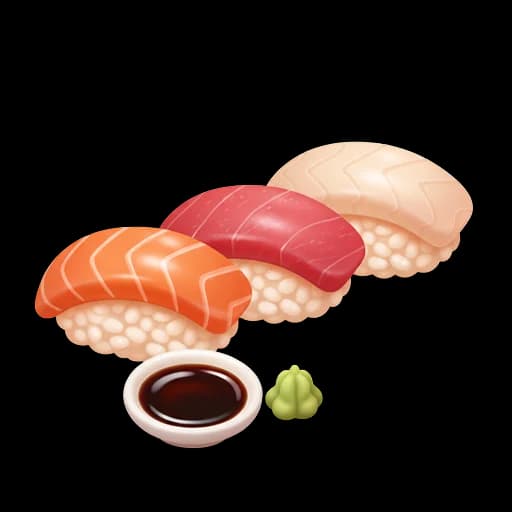
The list is compact and reads like an argument for a few good fish rather than a catalogue of rolls. Chirashi Don is the clearest first order, a bowl that gathers salmon, bluefin tuna, shiromi, squid, and tamago over sushi rice — a way to taste the counter's range without assembling a full nigiri set. The bluefin runs in two cuts held side by side: Chutoro Bluefin Nigiri for the medium-fatty richness, Akami Bluefin Nigiri for the leaner, cleaner edge. Hotate Nigiri brings Hokkaido scallop and its sweetness; Kanpachi Nigiri carries yellowtail; Ikura Nigiri finishes with salmon roe. The rolls stay close to the fish too — a Negitoro Maki of chopped bluefin with scallion and chive, a Futomaki packed with tiger prawn, salmon, and shiitake — and even the miso soup is built on seafood rather than plain dashi. Beyond the singles, the fish also comes by the tray, so one person can order a single bowl and a host can feed a crowd off the same short list.
What the counter leaves off says as much as what it keeps. There is no long specialty-roll section engineered for variety, no dining-room theatre, no rotating board of specials — the choices stay narrow because the fish is meant to be the whole argument. The dry-aging is not a gimmick bolted onto a sushi menu; it is the reason the menu looks the way it does, a few days of rest drawing more out of each fish before it is ever sliced. The wholesale and catering lanes still run alongside the retail counter, and that is the quiet logic of the operation: a kitchen that already sells fish to other kitchens keeps its own menu short and technical, because it has nothing to prove past the quality of the cut.
The shop is the work of three operators — Edward Bang, Jason Ching, and Jeff Kang — whose names connect it to a small constellation of Toronto kitchens, among them Omai, Ikune, and Apres. According to local reporting, the group framed Oroshi as a fish-first idea from the outset, the commissary as the foundation and the counter as its public expression. Bang has been the one to explain the concept publicly, describing a shop built to put fish handling ahead of everything else; the three were already working with fish elsewhere and wanted a place organized entirely around it rather than around a dining room.
Finding Oroshi is part of the character. The counter sits behind a blue door off Bill Cameron Lane, a west-end laneway address more than a storefront on the main drag, and it runs takeout-only, with a few outdoor benches for anyone who wants to eat close by. The party trays — forty- and sixty-piece sets, plus a larger Choice Set — turn the same fish into a group order, and the catering path scales it up again for a table eating somewhere else entirely. That is the whole shape of the place: order ahead, pick up behind the blue door, and let the fish finish the job at a table it never had to set.